The Golden Era of Culinary Apprenticeship, The 90s Corporate Takeover…, The Collapse of Culinary Education, etc.
By Culinarian Solutions
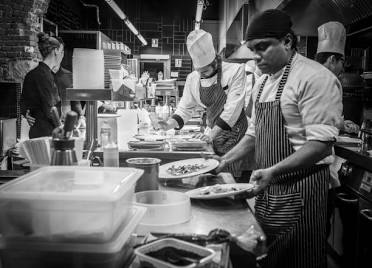
If you own or manage a restaurant today, you already know the quintessential problem facing the food service industry: a massive deficit of skilled culinary professionals.
It’s a familiar, frustrating cycle. Restaurant owners and managers often lack formal culinary training, which leaves the critical tasks of food preparation, presentation, and recipe costing entirely in the hands of the kitchen staff. The problem? Today’s labor pool rarely possesses the formal education or training to execute these tasks efficiently. The result is a perfect storm of high turnover, costly mistakes, bleeding profit margins, and unnecessary operational stress.
But how did we get here? To understand how to fix the modern kitchen, we have to look at how we broke it.
The Golden Era of Culinary Apprenticeship
Decades ago, the culinary industry was built on a time-tested foundation of mentorship and apprenticeships. Young professionals who aspired to be chefs didn’t just step onto a line; they worked shoulder-to-shoulder with qualified Master Chefs. They learned classic techniques, food management, and the respect required to handle raw ingredients.
Alongside this apprenticeship model stood the elite national culinary institutions—like the Culinary Institute of America in Hyde Park and Johnson & Wales University—which provided rigorous academic discipline to complement hands-on training. The industry was driven by mom-and-pop operations where qualified chefs created menus and fabricated dishes entirely from scratch.
The 90s Corporate Takeover and the Deskilling of the Kitchen
Then came the 1990s, and with it, the corporate takeover of the restaurant industry. The focus shifted from quality to aggressive scaling. Scratch cooking was replaced by convenience.
Instead of employing skilled cooks to fabricate food using classic techniques, the industry turned to factories. Food was processed, packed with additives, and distributed by mega-suppliers. Corporate America quickly realized they could stop hiring talented, higher-paid culinary professionals. The job was downgraded from a craft to an assembly line: empty a can into a pot, heat it up, or pull a bag out of the freezer and drop it in the fryer. Skill was no longer required, so hiring defaulted to whoever would work for the least amount of money. Naturally, the quality of dining plummeted.
The Collapse of Culinary Education
As the industry deskilled, culinary education faced its own reckoning. The government cracked down on the student loan crisis, forcing colleges to prove that their steep tuition costs were justified by their graduates’ starting salaries. In an industry that had spent a decade artificially suppressing kitchen wages in favor of processed foods, the numbers didn’t add up.
This led to the abrupt closure of hundreds of culinary schools across the country—most notably the mass shuttering of Le Cordon Bleu campuses. The pipeline of trained professionals who understood proper cooking techniques, classic recipes, and kitchen management dried up completely.
The Modern Catch-22: What Consumers Want vs. What Kitchens Can Do
Fast forward to today. Over the last 20 years, consumer dining habits have radically shifted. Diners have become health-conscious; they are rejecting heavily processed, chemical-laden foods in favor of fresh, high-quality, from-scratch meals.
This has left restaurants trapped in a brutal Catch-22. On one hand, clients are demanding fresh, quality food. On the other hand, the cost of relying on processed convenience foods now far exceeds the cost of preparing meals from scratch using fresh ingredients. Yet, because the culinary schools are largely gone and the apprenticeship model has long disappeared, restaurants simply do not have the skilled labor to pivot back to scratch cooking.
The Culinarian Solutions Approach: Bridging the Gap
This is exactly why Culinarian Solutions was founded. As a boutique culinary consulting firm, our mission is to help restaurants navigate this crisis, improve their food quality, and drastically increase their profitability.
My own background bridges the gap between the two lost pillars of culinary excellence. Having apprenticed under French Master Chefs in the early 1980s and subsequently graduating from Johnson & Wales, I possess both the hands-on understanding of the traditional apprenticeship model and the rigorous academic discipline required for modern menu creation and precise recipe costing.
At Culinarian Solutions, we don’t just hand you a new menu and walk away. We bring the apprenticeship model into your restaurant. We teach your staff how to execute classic culinary techniques, we standardize your recipes, and we implement the operational systems needed to lower your food costs while elevating your final plate.
For me, this work goes beyond making a living. It is a fundamental obligation to give back what was freely given to me. My mentors gave me the knowledge, skills, and respect for the craft that defined my career. Now, it is my privilege to pass that torch to the next generation of kitchens—helping your restaurant not just survive, but truly thrive.
Ready to bring profitability and pride back into your kitchen? Let’s talk.
Leave a Reply